
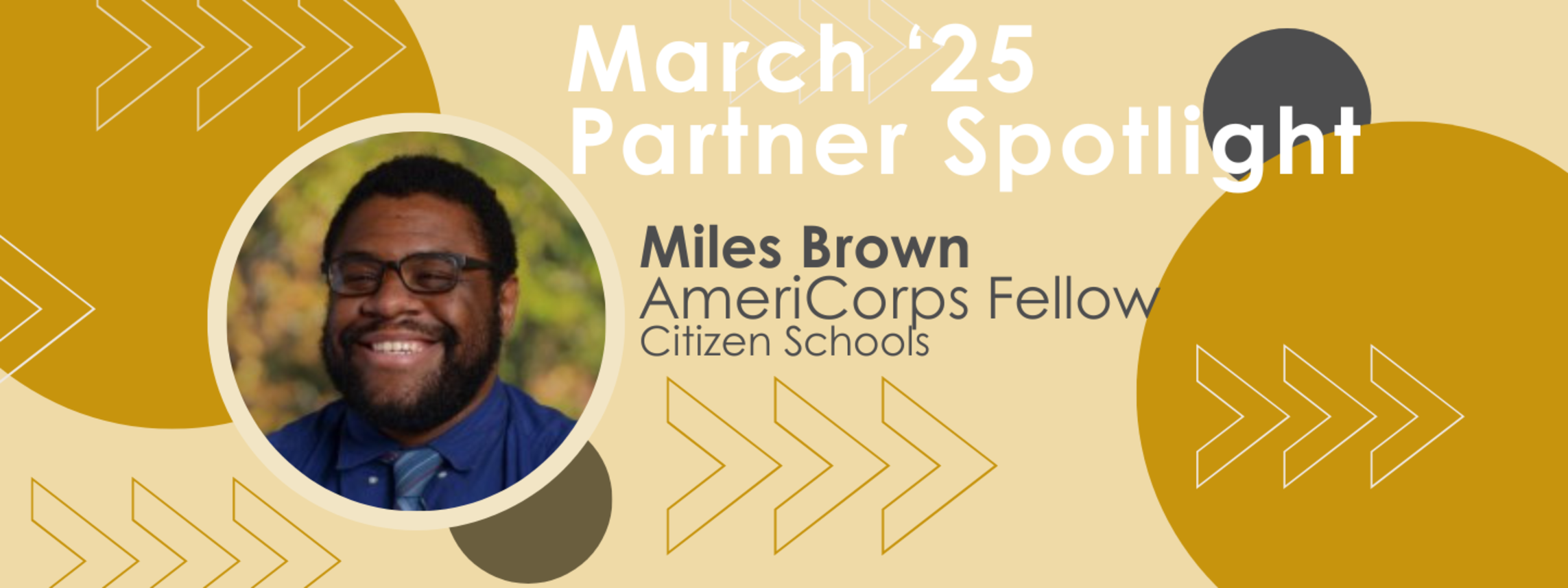
Miles Brown Partner Spotlight
This week is AmeriCorps appreciation week, and we want to release an additional Partner Spotlight highlighting another one of our amazing Fellows. Miles Brown is a dedicated individual with a strong commitment to educational advancement. Currently an AmeriCorps VISTA Fellow serving at Creo College Prep in the South Bronx while pursuing studies in education policy, Miles brings a valuable perspective to his work with Citizen Schools. His focus on centering students' experiences and fostering community engagement highlights his dedication to creating meaningful impact. Miles' efforts in optimizing community outreach and supporting new educators further exemplify his positive contributions to the educational landscape. We are excited to share his story with you.
What drew you to the AmeriCorps and Citizen Schools mission and approach? Share a little about your journey that led you to CS. My journey, especially with AmeriCorps, really began almost 10 whole years ago. I was a City Year Corps member in my hometown in Milwaukee, and that was truly a life-changing experience. It made me want to go into education policy, and I've carried all the lessons I learned through that AmeriCorps experience with me.
When the opportunity came up to go back into AmeriCorps, after I spent seven or eight years in the classroom in various positions, I really felt like the mission of Citizen Schools was a perfect match for what I wanted to do. Being able to think about things differently, fostering the future of education and figuring out ways to really center the students in their own experiences are all things that throughout my teaching career, I've always tried to do. Most importantly centering the students. That for me is the one reason why we do this, is to educate kids, and I feel like that's something that's way too lost in the shuffle because of various reasons.
I am in school for education policy, and I've learned about being in broader scopes and experiential education. This opportunity was something that I felt was a way for me to put all that I've learned in grad school at that point into Citizen Schools. Things like equity audits and community databases are things that I have read about or done in a simulation bond, but this was a chance for me to do it in real life, and I really jumped at the opportunity.
I had been in the classroom for a while, and I was looking for a way to have a more systemic impact. I wanted to see how I could contribute to the bigger picture of educational reform, and Citizen Schools, with its focus on Experiential Learning and Community Engagement, seemed like the perfect avenue. It felt like a chance to bridge the gap between theory and practice, to take what I'd learned in my studies and apply it in a meaningful way. The idea of working directly with students while also contributing to broader organizational goals was incredibly appealing. I was also drawn to the emphasis on equity and access, ensuring that all students, regardless of their background, have the opportunity to succeed. That's a value that's always been central to my work as an educator, and I was excited to be part of an organization that shared that commitment.
What does Experiential Learning (EL) mean to you, and why is it important? What would it look like to truly learn experientially? Going back to my studies, I believe an educator a century ago by the name of John Dewey started using the term Experiential Learning and he really talked about having kids actually do things in the classroom. It was the building blocks for Experiential Learning today talking about learning being for life, and preparing for life. It is about making sure that kids are able to follow their interests and not be burnt out by school or fall out of love with learning. I feel like Experiential Learning gives students the opportunity to see an aspect of a career that they could possibly pursue because allows students to follow their own interests and hopefully leads to better educational outcomes down the line. I also feel like Experiential Learning is when students are doing the work and really engaged in the work to the point where it doesn't feel like work for them. The hope is that it is something that they enjoyed doing.
Something I feel like is a huge part of Experiential Learning is having familiarity with the community through meaningful community engagement. Being able to know what's going on in the community, the different programs that are happening for students and how they could help the larger community. Schools could be an example of how to do that and have that at the forefront of their approach.
To truly learn experientially, I think it means moving beyond memorization and passive learning. It's about creating opportunities for students to actively engage with the world around them, to explore their interests, and to develop real-world skills. It means designing learning experiences that are relevant and meaningful, that connect classroom learning to real-life applications. It could involve things like internships, apprenticeships, service-learning projects, and hands-on simulations. It's about creating a learning environment where students are encouraged to ask questions, to experiment, and to learn from their mistakes. It's also about fostering a sense of curiosity and a love of learning that extends beyond the classroom walls.
What do you believe is the best first step towards advancing the future of learning? What is necessary to make it successful? One realization for me is the way that we've been doing things in education hasn't really worked or changed in the last century. That is something that has really led to a failure of the system where kids are graduating with honors, but are functionally illiterate. A lot of different policies from the last 30-40 years rely on high stakes testing which makes it so that there is no joy in learning for the students. It's almost like instead of rising to the academic pressure, students kind of wilt from it and it causes them to not really trust academic institutions or be able to develop a love of learning.
So I do feel like it's not working and I think one thing that can be done is investment in education. This is not just financial, it's also about the people that are in education. In some inclusion classes, you have a kid in 8th grade at kindergarten reading level and it gets put on the teacher to be able to work the miracle of bringing them up to speed. Because there are teacher shortages, we've relied a lot on one educator to serve all kids but kids are different. They need different things in order to be able to rise up to grade level work. That’s one of the things I really like about my current host site, Creo College Prep they really separate the kids as far as ability level, and the kids can find commonality with one another. This allows students to work in smaller groups on the things that they really need in order to rise up to the next level.
I feel like far too often, we assume that a one size fits option has to work. People have to make it work, and if not, they're flawed as educators. I am thinking about my last role where I had probably four or five students who needed paraprofessionals and needed a class that was half the size of what I actually had to teach. I was told I wasn’t a good enough teacher but there are insurmountable odds to face. We have to make things easier on teachers, where they can focus on the craft of teaching and we should be empowering them. But too often it's not the case. It feels like we're all pretending that everything is fine, but there are really deep flaws within the educational system, and the first step is actually realizing that and doing something about it.
Who is the most influential mentor you have had throughout your life? What qualities did they impart that you continue to embody in your work? I had a lot of great mentors but one really stands out. In 2017-2018 I worked at a school for kids with learning disabilities where every single student had an IEP. The person who impacted me most there was a mentor named David Jagielski who had been teaching for 15 years. There were qualities he taught me that I still embody today and still really drive me.
One of them is always keeping the joy factor in mind for students and for teachers as well. I feel like we talk about the joy factor for students, but teachers have to be able to show their own passion and love what they do. I think that is something that keeps the students engaged and helps build relationships. Mr. Jagielski was really passionate about Rockabilly culture and velvet Elvis paintings. One day the kids asked him 15 minutes worth of questions about it, and he just stopped class and answered each of them and then went back to the lesson. That showed me that even if you're on a tight schedule you have to really cherish those times, because again, it's about relationship building and engagement in the class, and really making students feel like they can ask anything.
The other thing that comes to mind is the concept of fairness in education. I think the first time I'd heard him say it was asking the students ‘was the test fair?’ I remember thinking ‘does it matter if it's fair? They have to do it.’ But it is very important to make sure that students have opportunities to do work in a fair and balanced environment where things aren't unfair for them. Because if that is not the case, then a lot of students will not buy into what they're doing if they feel like there's no chance for them to be successful. Making sure they have equal opportunity to be successful and that things are fair for them so that it builds trust.
Finally, he taught me about legitimacy in teamwork, especially with co-teaching. This means both instructors have to be on equal footing in the classroom for class to be effective. Both teachers have to take action to ensure this happens. One thing that can happens with co-teachers is a student may try to play their teachers against one another. Also, if there's a teacher less experienced in the classroom, students will try to serve their authority or try to not act like they're a legitimate member of the classroom. I feel like that was something that when I had a co-teacher, I tried to really embody that we're both in the classroom, both here to help students, and we both have to have an equal plane of respect within the classroom space, because if not, then power struggles start to happen.
Can you share a story about a student or teacher or employee whose life was positively impacted by your service year? I have been working to build rapport with different community organizations during this first half of my service year. The Creo Prep team identified the enrollment team as a good start to engage with the community. During the second half of the service year we hope to bring people in and have students go to these places or share their stories about how these places have impacted them, so been really able to work with the enrollment team optimizing community outreach opportunities. One thing I'm proud of is being able to have a legitimate database of organizations to pull from. It has been really nice to be able to compile something that could potentially be used for a next Fellow who may be at the same school. We have also been working on different systems which have been modified over and over, and I do feel like it has helped me a lot. Working with the enrollment team and even though it feels like something that is like being built on the fly, which has its own complication, but it's been really great working with them.
Another thing I can be really proud of is that when I was taking a family and community engagement class, I had profiled my old private school that I worked at which is a very expensive and well-resourced school. One of the interesting things about that school is that some of the largest housing projects in the city are across the street. They had not been hosting events to the larger community which I felt like was a missed opportunity for them. I brought this up to the enrollment team here at Creo and was really heartened by the fact that it seems like within the next few months there are going to be open events, not only just students, but to the larger South Bronx Community. The school is only six years old so this has the potential to really make an imprint in the South Bronx. Also for the school, there is a lot of charter competition around and it's really tough to set yourself apart, and I do feel like community engagement is a key way for Creo to do it. And just really feels great that they've been able to have these events, and really optimize the community outreach.
It's really been an awesome experience that I've learned a lot from. Also I think there's a lot of newer teachers here, and even though I, at the beginning felt like, oh, what can I offer them? I wasn't really confident in my own skills as a teacher. But it's been a really great opportunity to give guidance to some newer teachers and to impart some of the things that I've experienced and gone through as a teacher, to help them out on their journey as teachers, which helps the overall class or overall school environment through stronger teachers.