
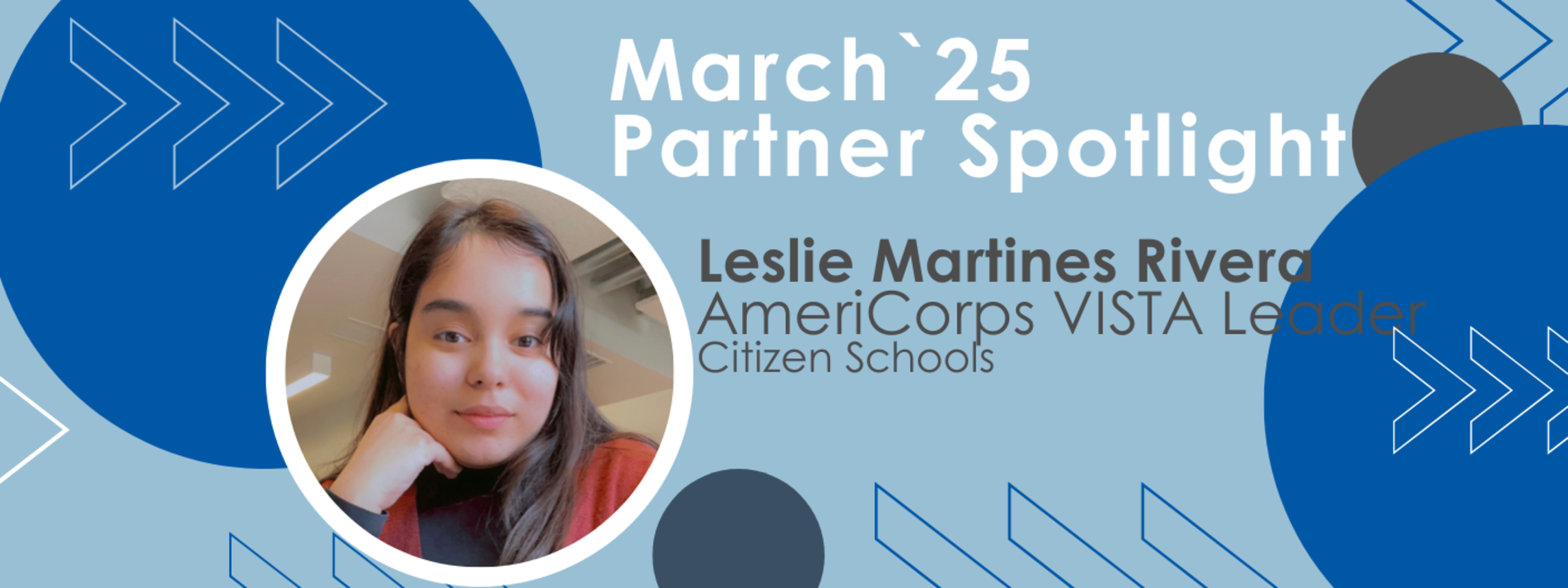
Leslie Rivera Partner Spotlight
In this edition of our Partner Spotlight, we sat down with Leslie Martines Rivera who currently serves as an AmeriCorps VISTA Leader here at Citizen Schools. Citizen Schools' AmeriCorps VISTA Fellows are at the forefront of innovating the future of education. Placed throughout the country, our Fellows are working to build capacity for their host sites and expand the impact that quality learning can have on the community. As an AmeriCorps VISTA Leader, Leslie serves as an experience mentor and facilitator, directly supporting VISTA Fellows to maximize their impact and ensure project success. She strengthens organizational capacity by providing guidance, training, and operational support, ultimately contributing to the program's overall effectiveness. It takes a special person to dedicate themselves to service and we are thrilled ot share more about her work and journey.
What drew you to the AmeriCorps and Citizen Schools mission and approach? Share a little about your journey that led you to CS. This is my fourth year of service and my third year with Citizen Schools, and I was first introduced to AmeriCorps right after college. In my first year of service, I saw this position available at Alvernia University which is where I graduated from, and it was to be a nonprofit internship coordinator. It was a great experience and I loved interacting with the students there. That said, I have a degree in Criminal Justice Administration So I decided to try to go back into law as a legal secretary. I quickly realized that it didn't resonate with me because I was feeling so connected to the nonprofit work I had done. When I was the nonprofit internship coordinator, it was primarily for first generation college students, or low income students and I got to connect with them. I just felt like I was helping and I could see short term and long term effects of my work during my service year and I was not having the same impact.
So I started looking for AmeriCorps positions and found Citizen Schools, first as a VISTA Fellow, and now this is my second year as an AmeriCorps VISTA Leader. As a VISTA Leader, I get to have 1:1s with the Citizen Schools VISTA Fellows and see the amazing impact that they're having. I'm kind of their coach, since I've gone through the system. If they are having issues, or need guidance on how to approach a conversation or problem I am able to give them feedback and professional development opportunities. Every year it is a new cohort who I get to help nurture and reach their goals.
What drew me and kept me with Citizen Schools is we preach Experiential Learning for the sites, educators and students we partner with so that they can get the most of their education and participate in real hands-on learning. We want students to get experience that's going to really serve them outside of school and help them grow as an individual in life. We also do that with our Fellows, we practice what we preach.
What does Experiential Learning (EL) mean to you, and why is it important? What would it look like to truly learn experientially? For me, Experiential Learning is what I think has been called hands-on learning. It’s about putting real-world stakes on the students and the projects that they are a part of. I feel like learning can happen anywhere.
At Citizen Schools, we're trying to integrate it into the classroom. Each class picks a project that they want to work on and then they bring in people from the community to talk and mentor the students. And then the students have a place to start and a project that can be done.
This learning could also happen in an after school program. My first year I was working at the Carnegie Science Center, and they were running two Maker centered after school programs, one with high schoolers and one with middle schoolers.We did classes where the students partnered with STEM mentor volunteers from the community and learned how to design on programs and 3D printers or laser cutters or even how to solder. Then they pick a project that they cared about in society or their community that maybe one of their ideas would help solve. We had a student who had noticed that he had a lot of stray cats in his neighborhood and when winter comes they hide under tires or that sort of thing. So he decided we should build tiny homes that they can go to. Another student was concerned about the homelessness population. They went into such detail about laws and disability regulations and made up a model with all of the dimensions for a tiny home made as cheap as possible. At the end they presented to their parents, the mentors and some community members and donors.
The middle school program was similar with the key difference being we encouraged them to build the business around their idea. The goal was to use all of the tools that they learned and create something and we would help them start to sell it. One student made earrings that she laser cut, another student made 3D printed figurines and another did this little flower pot. They also needed to name their price too and keep any of the money they made. It showed them that college is an option, but you could be an entrepreneur, you could be an artist, you could be an artisan. Again tying back to real world stakes.
What do you believe is the best first step towards advancing the future of learning? What is necessary to make it successful? When we talk about advancing the future of learning, I think the best first step is attention to detail with students. It’s not going to be one size fits all. Each student is going to need something different. And to make it successful, I think all classrooms should not just have one teacher, but should have an assistant, or maybe two.
I’ll give you two examples. My reading scores were very low. When I read aloud I would stutter. I was always below average. Then, in fifth grade, they did Reading Edge, grouping students by reading level. My group read a book about eating insects. Weird, but fascinating! I was hooked. We finished, and I asked, “What’s next?”, then found more at the library. I went every day, even weekends. I even won an iPad for reading all because a teacher took the time. We were in a small group, all at my reading level, I didn’t feel slower than anyone. Someone who has a passion for reading, and someone who takes the time, that’s what makes a difference. And sometimes, you need that extra person to come around when you’re slower in math, or whatever. One teacher can’t do that. So, for me, it would be having multiple teachers in a classroom, and bringing back grouping by reading and math level. 30 minutes to an hour a day working in groups with others at the same level, to scale upwards that way, advanced students aren’t bogged down either they have just as much right to attention.
The other story is about Michael, from the Carnegie Science Center program. He was like me, always below average, distracting class. He was embarrassed because everyone else understood the software, and he didn’t. He’d say, “I’m dumb.” He’d get angry. I’d sit with him and tell him, “No, you did it!” He thought no one would buy his design but ultimately he sold many! He was the only student to come back and teach his grandma and cousin how to use the tools.
When the program ended, he asked, “But you’re coming back, right?” That’s because there was the regular teacher, and I would be floating around asking “What step did you miss? You’re fine, let’s keep going.” They just need encouragement. One teacher would be too busy. He’d just give up, be the problem child, go to detention. They internalize that, call themselves stupid, don’t even try. But when you do try, you can achieve something. He proved it to himself. It opens their eyes to an infinity of possibilities.
Who is the most influential mentor you have had throughout your life? What qualities did they impart that you continue to embody in your work? The most influential mentor in my life, outside of family, is Susan who was a volunteer mentor for the Poetry Out Loud program in my high school. She is a retired English teacher, over 30 years in the district, and when I met her, she taught AP English, German, and French. She has a vast knowledge of art, literature, and poetry. She's so sharp, so poised. and had clear enunciation. I was just in awe of this strong, independent woman.
We worked together all four years of my high school. I was in the Poetry Out Loud program, memorizing poems, reciting them in competition. She was with the school for years and even now, I keep in touch with her. She really taught me the importance of precision in language, the beauty of articulation, and the power of poise. It's not just about what you say, but how you say it. She embodies a kind of classic grace that I find incredibly inspiring.
Beyond the language, it's her unwavering dedication to knowledge and her passion for literature. She instilled in me a deep appreciation for the arts and a commitment to continuous learning. And she always encouraged me to strive for excellence, not just in poetry, but in everything I do.
What I carry with me from Susan is a constant pursuit of knowledge. She taught me to value the power of words, both spoken and written, and to approach life with a sense of elegance and purpose. And even though she's retired, her influence continues to shape how I communicate and interact with the world around me.