
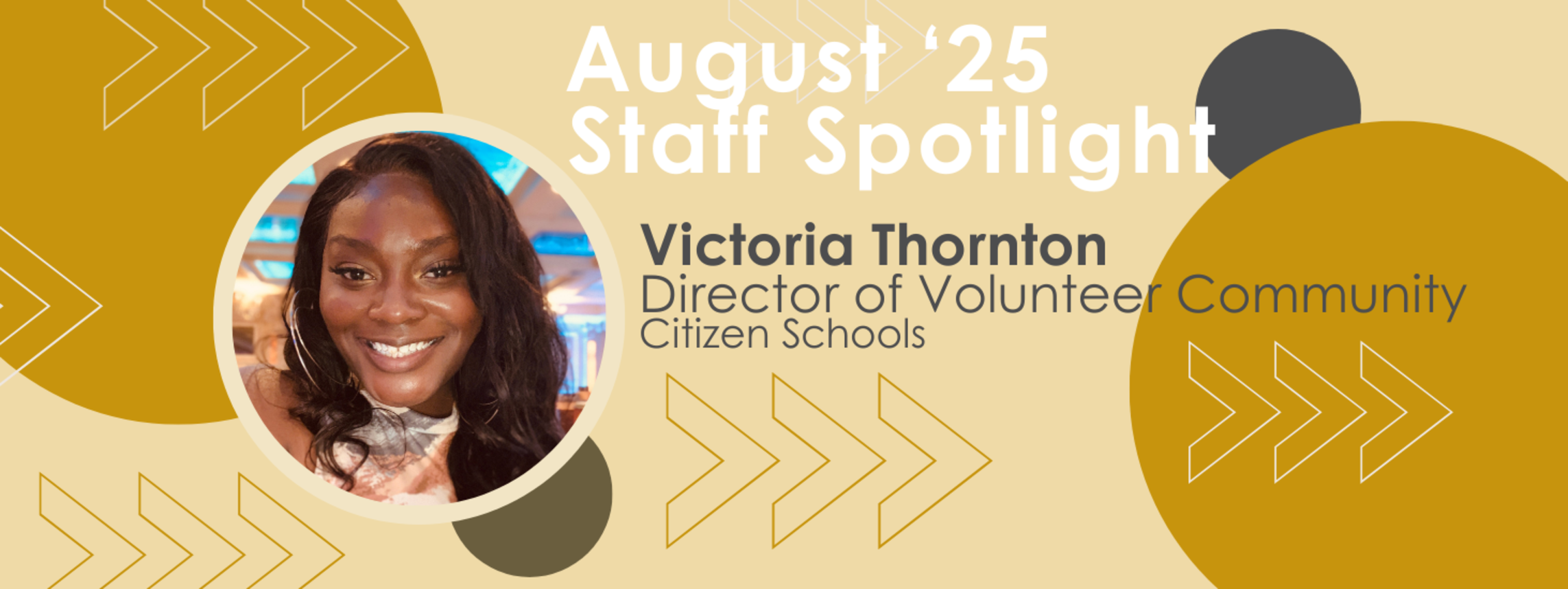
Victoria Thornton Staff Spotlight
At Citizen Schools, our staff bring curiosity, passion, and commitment to community into every part of their work. Through our Staff Spotlight series, we’re sharing the stories of the people who make our mission thrive from behind the scenes.
We’re excited to introduce Victoria Thornton who leads the volunteer and mentorship arm of our work on our Program team. Throughout her education and career journey, Victoria discovered a love for building community coalitions and sparked a passion for volunteer management and mentorship. What inspires her most at Citizen Schools is our focus on representation—ensuring students see mentors who look like them, sound like them, and can show them what’s possible.
For Victoria, it’s about more than just hands-on learning; it’s about creating authentic connections where students feel seen, supported, and inspired to dream big. Stay tuned as we continue spotlighting the incredible people shaping the future with Citizen Schools.
What drew you to the Citizen Schools mission and approach? Share a little about your journey that led you to CS. In college, I landed with two majors, Urban Studies and Political Science and not because I had a connection to either of those, but because those were the classes that I really excelled at. You don't necessarily need to know what you want to do, but look internally. What skills do you already possess? What feels natural and instinctual? And then run with that.
After college I joined AmeriCorps and I did a service year with the New York City Housing Authority. Not only did this get me to New York City, but I was placed in a city agency and it started me in volunteer management. My role was to work with the residents of the various housing complexes that the city manages, and get them to start up green community initiatives like gardens, murals and recycling initiatives. I really fell in love with recruiting folks to help build something within their own community. I started 6 or 7 volunteer coalitions during my service there and then those coalitions started recruiting their own volunteers, while I supported them in writing small grants to get materials for their work. Getting others excited to give back and do something that feels right for them, that also is impactful for the community is what inspired me to continue in volunteer management.
I was also drawn to the mentorship piece of volunteer management which led me into the youth development space and ultimately to Citizen Schools. At Citizen Schools, I really am drawn to the fact that representation is the number one priority when it comes to our volunteers. We are truly looking for someone to be able to stand in front of these young people that we serve and say, I do X, Y and Z, I look like you, I sound like you, it is possible for you to be this too.
For me growing up, it was one type of person that had corporate jobs, or was in government or was leading local businesses. Or at least that's all I saw. And they rarely looked like me, so I never felt seen or really thought I could do that. Now in my role at CS, to be able to turn around and intentionally find people who will connect with our students on multiple levels is such important work. It connects so deeply to hands-on learning, because you not only have somebody that looks, sounds, feels like you, but they're also doing the work with you as a partner in this learning journey. Our volunteers are there as true mentors, not to give students a grade but instead to be engaged in the learning with them. I love that approach.
What does Experiential Learning (EL) mean to you, and why is it important? What would it look like to truly learn experientially? Experiential Learning to me, is learning by doing. It is being able to touch and feel what it's like to be in a specific situation and scenario. When it comes to Citizen Schools, I really love the projects that we're able to develop because they center a situation that doesn't feel adjacent to students' lives. The goal of our projects is to center a historical lesson and showcase not only how it impacts us today, but how it repeats itself.
For our young people to be able to see this connection in a real life scenario and by working through that problem and solving it in real time is where the true learning comes in. I think that's why Experiential Learning is important, because it is not about reading something in a textbook and memorizing it. Instead, we let the students play things out and work through a particular issue. When they finish, they have applied it and can apply those learnings to another real life situation. Experiential Learning allows students to see why different types of lessons matter to them and how they play out in their lives. It allows them to see how it plays out in society and home life.
What do you believe is the best first step towards advancing the future of learning? What is necessary to make it successful? First, I think it is so important that we listen to our students. For Citizen Schools, I think that is partially how we got here because we were listening to the needs of the Boston community. Our young people didn't have a place to go, they were ending their school day early, and there were still gaps in their academic achievement scores. We paid attention to those realities and then listened to the interests of our students and allowed them to impact their own learning. This step creates an environment where young people are excited to be engaged in what they're doing.
Sitting in a classroom listening to a teacher provide them content may excite some people, but the future of learning needs to empower our students to be able to go after whatever careers, futures education that they want. The future of learning should be able to equip our students to be active parts of their community both locally and on a larger scale, and should encourage our young people to step into leadership positions. We should encourage students to change things that they want changed in society and to make it a better place.
In order to do that, we have to listen to students and understand where they're coming from. For us to shape a classroom that inspires and motivates students to do all of these things, we need to understand their needs and interests and localize the learning experience to those needs and interests. We also need to build in reinforcements to help make this happen and so that the teacher does not bear the full burden of this work. Teachers should not have to develop children into the next generation of leaders by themselves. We need to equip our teachers and schools and provide them with the resources and connections they need. As a society, we need to provide them with multifaceted systems that support students holistically, support the school community, and ensure that our students are not only grappling with content, but they are embedded in what's happening in the community. That comes from having schools partner thoughtfully with organizations, and corporate partners, and government officials who can layer in those resources for the student and for the whole school.
Who is the most influential mentor you have had throughout your life? What qualities did they impart that you continue to embody in your work? I have not had a mentor in the traditional sense, but what I have had are short term experiences with folks that I still hold onto now. I consider them meaningful mentorship moments. I also say this to our Citizen Schools volunteers, you don't have to be with a student for a very long time in order for that mentorship to be truly impactful.
What got me inspired to go to grad school was a conversation that I had with my first mentor. She's the CEO of a nonprofit, a black woman and at the time was in her mid 30s. I was in awe of this woman. I had a conversation with her at a time in my career where I was starting to feel stuck in the role that I had. It did not feel like my organization wanted to promote me past my current position and I was trying to figure out, how do I showcase myself? I did not know what next steps to take and so I reached out to her for guidance. She told me that sometimes companies don't see your worth until you leave. She said you have to do everything you can, to be as visible as you can while you are in an organization and showcase your work and ability. She encouraged me to strategize and think thoughtfully and show that I am willing to go the extra mile. She also said there may still come a point where you will feel like you're not being seen and if that happens not to feel tethered to that space. Because of that conversation, I went to grad school. She encouraged me to think more of myself than I was because I saw myself as the role in the organization instead of where I wanted to go. She taught me in order to push yourself, you need to reflect inward. I needed to equip myself more in order to push to the next level.
The quality that I love about her is not just who she was. Yes, she was this powerful black woman who didn't stop at anything and made a huge dent in the mentorship space by starting her own nonprofit. What I love is that she was able to meaningfully see qualities in me and push me to think better about myself. That is the quality that I love in any mentor, is that they can see you and say ‘you can do so much more.’ Mentors who are able to encourage you to look at yourself and think critically about what skills you need to develop, what you need to get where you want to be and what needs to change to make that happen. I love that about her and I try to use that in my work with others and still how I focus on pushing myself to the next phase.
Can you share a story about a past partner who inspired you through their involvement with Citizen Schools? We had a volunteer, Terry Lewis, who I recruited when I first got hired at Citizen Schools. He lives in Memphis, Tennessee, he's a black man, he has always been in the mentoring space and he works in the insurance space. He came in with the best attitude sharing how much he loves mentoring and that he wanted to get as involved as he could. We found a project that was focused on financial literacy and helping students understand budgets, savings accounts, credit, how to save for college and what it would look like to start right now as a middle schooler. The project helped students think about what their savings would need to be in order to pay for their own college and not depend on a loan or others. Then once you are independent, what would a budget look like? How would you be able to sustain your lifestyle?
The teacher on the project specifically requested a volunteer who looked like their students who were mainly black and brown, because he wanted to give them the opportunity to work with someone who they would have that initial spark of commonality with. The connection between the teacher and Terry was instant before the project started. They were collaborating on what they each could bring to the table for the students and as a result Terry connected instantly with the classroom. It truly was a match made in heaven.
When I saw that collaboration, I wanted to bring this to all of our projects. It's not just finding a good volunteer who's going to connect with the students, but it is the support and partnership with the teacher. Our volunteers are a resource to the students, of course, but also there's a burden of educating these young minds that primarily falls on our teachers. It was so beautiful to see this educator relax in the space when Terry was able to connect with all of the students so naturally and so effortlessly. That was the collaboration I built our volunteer matching system off. We want to focus on: What does the student need? What does the classroom need? What does the teacher need? How can we match all of those together? And that is when the magic happens.