
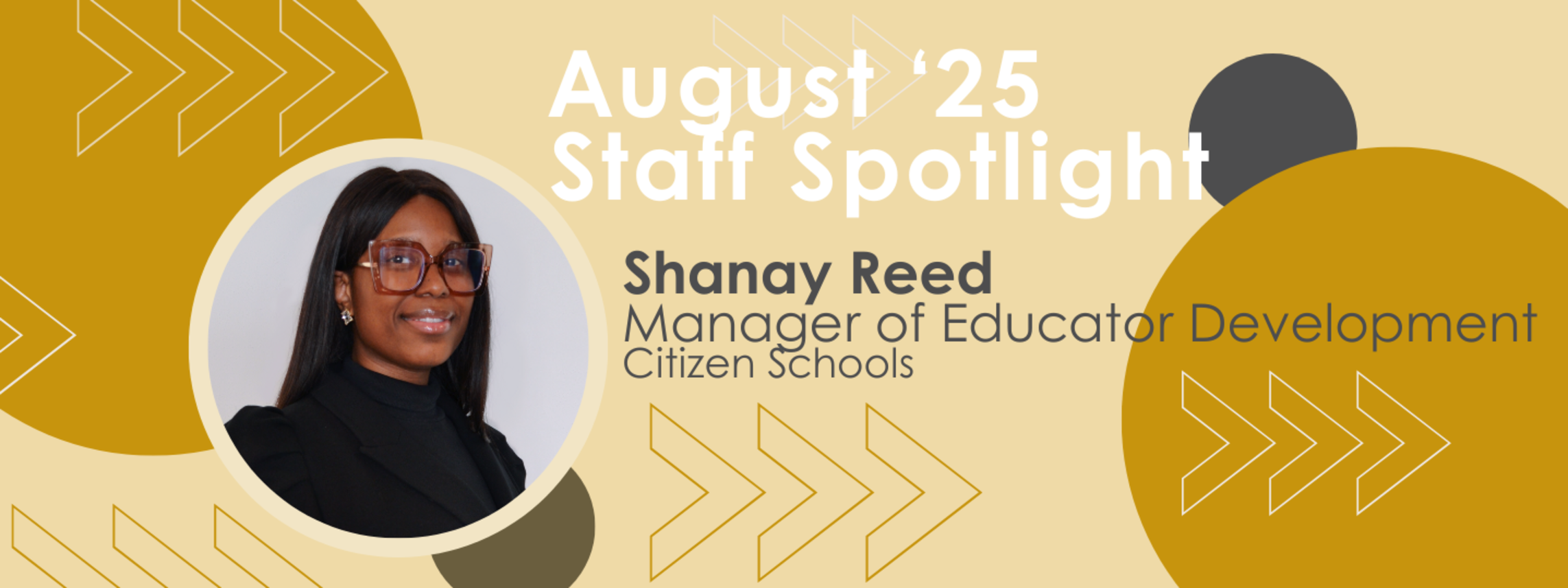
Shanay Reed Staff Spotlight
At Citizen Schools, our work is powered by incredible people who bring passion, purpose, and authenticity to everything they do. This month, we’re excited to launch a new Staff Spotlight series, introducing you to the team members who make our mission come alive every day. We’re starting with our Program team—the folks driving the research, design, and implementation of our work in communities.
In this article, Shanay Reed, our Manager of Educator Development shares how her journey from paraprofessional and AmeriCorps member led her to Citizen Schools. For Shanay, education has always been the kind of work where—even in stressful moments—she can see her effort making a real difference.
Shanay shares how she was drawn to Citizen Schools’ deep commitment to inclusivity and cultural competency—values she says aren’t talked about enough in the workplace. She highlights the transparency and authenticity of our team, who encourage one another to bring their full selves to the work and to embrace flexibility in service of our mission. We are excited to share more about what drives us to activate this work!
What drew you to the Citizen Schools mission and approach? Share a little about your journey that led you to CS. What really pulled me into Citizen Schools was that it was a way to still be involved with education, but from a different standpoint than leading a classroom or behavior management. I had already worked as a paraprofessional before, and I had worked with a school as an AmeriCorps member. Education felt like the only work that I did that felt meaningful. I've had a lot of jobs, and there's so much stress from work, and then you wonder what is really gained from it? With education, even if there is stress, I can see where my work and my effort is benefitting others. When I came across Citizen Schools, I was excited about another opportunity to work in education, but from a vantage point that I hadn't really experienced yet. I wanted to gain some skills and be challenged while still doing something that was familiar.
I really care about the mission around being inclusive and providing different opportunities for all students. It was the first time that I had applied for a job where during the interview process we talked about cultural competency, and it was something that I loved, because I feel like that's not done enough. That is where I feel most aligned with our mission and what has kept me here. It has also been the team. There's a level of transparency that I've only experienced here at Citizen Schools. I've really appreciated the honesty and the push to bring our authentic selves to work. We push each other to talk about those things that are a little bit uncomfortable, and then change things and pivot when we need to. I feel like that level of flexibility and authenticity is rare.
What does Experiential Learning (EL) mean to you, and why is it important? What would it look like to truly learn experientially? For me, that phrase really just means life learning. Learning that is something that is useful to the student, or receiver of the information in real life, not just for tests, not just for an exam, not just to graduate, but a tool that they can use. It is about something that they can retain throughout their experiences outside of school as well.
It's really important because school is not easy for everyone, and it is a necessity for all students if they want to have a higher quality of life. It's important to have this kind of learning because otherwise you have teaching and learning that is so high stakes, but then they don't benefit from it once they leave school, once they get the degree. Getting degrees can help you get jobs, but they won't help you with the job itself. We don't really live in an equitable environment in the US, and so it's really important for all students to have opportunities to learn things and experience things that aren't strictly based in a traditional educational setting, and that are going to help them have tools in their back pockets that will benefit them in the real world.
As a student, I couldn't stand school. I think it's really hard to get students engaged. I constantly think back to myself as a student and why I didn't feel the desire to engage. I felt like a lot of the things that I was learning at the time didn't connect to me in any way. It's great to be on this side of things now, to really be thinking about what we can do so students' learning experiences make them want to participate. I think this work allows us to put the student at the center, helps them know they are cared about in the space, and that their engagement is desired versus enforced.
What do you believe is the best first step towards advancing the future of learning? What is necessary to make it successful? There are a few steps that I would highlight as important. I think the first step is that teachers should be allowed to build rapport with students before we start diving into the work. I don't feel like the first things we do needs to be focused on academics. We should focus on getting to know the school and the class dynamic and it is important for students to take time to learn the teachers' style and structure. This would allow students and teachers to feel they can be authentic and build student agency in their classroom. Being able to build the classroom community together would allow students and teachers to hold each other accountable to the elements that they highlighted as important.
Next, I think it is really important for schools to engage with volunteers, companies and businesses to engage the community. At Citizen Schools we do a great job of helping facilitate adults in classrooms and I have been really proud of our community centered work. I wish more schools had access to this experience for students because I know there are so many students who do not want to go to school. It is so beneficial to have other adults in their classrooms to help with this lack of engagement. First it helps with the intense student to teacher ratio. Next it gives them other adults in the space that they can talk to and learn from.
Finally, we should create a bigger space for creativity. There are not enough art related activities or creative outlets in public schools and that's really concerning to me. There are some traditional art classes that still get priority but not other avenues like theater. We worked a lot with STEM and technology focused schools who saw big increases in funding at a time. I think that work is very important too but I do not think it needs to be one or the other.
Who is the most influential mentor you have had throughout your life? What qualities did they impart that you continue to embody in your work? I really did not like school, and I was dealing with a lack of motivation to show up and do the work asked of me. I was taking night classes to graduate as well as school during the day, because I had skipped so much school that I was not going to graduate. And you can imagine, as educators my teachers were pretty freaked out. I was lucky because they felt like I had a lot of potential and when I would show up and do the work it was good work. I had a hard time focusing and I couldn’t imagine graduating and then going to college just to do it all again. School just was not for me.
One semester I found myself in AP English with a teacher named Ms. Summer. Ms. Summer was good friends with Ms. Boba and Mr. Haddad, who ran a robotics club and recommended that I attend one of the meetings. I had tried to join a couple of clubs, but robotics really stuck with me. There were volunteers from MIT who would come in to support us with building robots. One volunteer, Peter, I really remember. He just saw us as people instead of students and would talk to us about our interests and lives, as equals. He also would never make you feel dumb or like you were behind when you asked questions. He would just be excited that you were asking questions and it felt good to be rewarded for being curious for the first time. I had never experienced that before because asking questions tended to make people think I was not paying attention. The ability to question was really exciting to me. I was so happy to be at the competitions and even if we did not do well, it was really exciting and I loved it. Those three teachers saw an opportunity for me to connect with something outside of the classroom and it made a big difference for me.
My mentor in my adulthood, her name is Jenny Brown. She was a vice principal of a school that I worked at. What stands out to me with Jenny is she was incredibly real. It was the first work experience I had where she approached me and said she wanted to take the professional hat off for a second and talk about how I really felt about some of my work. She was super honest and she got a lot of criticism for that, but I really appreciated it. I really felt like if I were leading a team, I would want to have that same kind of leadership. I realized not everything needs to be so scripted and coded and sometimes transparency is what makes people realize you truly care. Even during the times she was giving you criticism, you didn’t feel attacked, you felt like she was looking out for you.
Can you share a story about a past partner who was inspired or transformed through their involvement with Citizen Schools? Some of my favorite Citizen Schools stories come from teachers who were nervous at the beginning of working with us. I worked with Stuart Whitney in Somerville a few years ago. He had some concerns about behavior issues in his class and that the time necessary to properly manage the classroom would end up impacting his ability to complete the project. We pulled back a lot of the layers of the project to just focus on what was essential for him. He ended up having more time to incorporate some of the initially scaled back ideas because his students were so excited to do their projects. He noticed their behaviors changing on days that Citizen Schools work was planned because they wanted to get to work. They wanted to talk about their research and work with their volunteers as much as they could.
One of our newer teachers, Jake Kessler, came to us already excited about the type of work we do but he was a little nervous about where to start. He was so dedicated to getting this right for his student and made the most of our coaching sessions. His student had so much agency over the project and he saw her come out of her shell through her engagement with the materials. When the program is structured and when the teacher really wants to participate in creating something unique for their students you can feel the impact directly.