
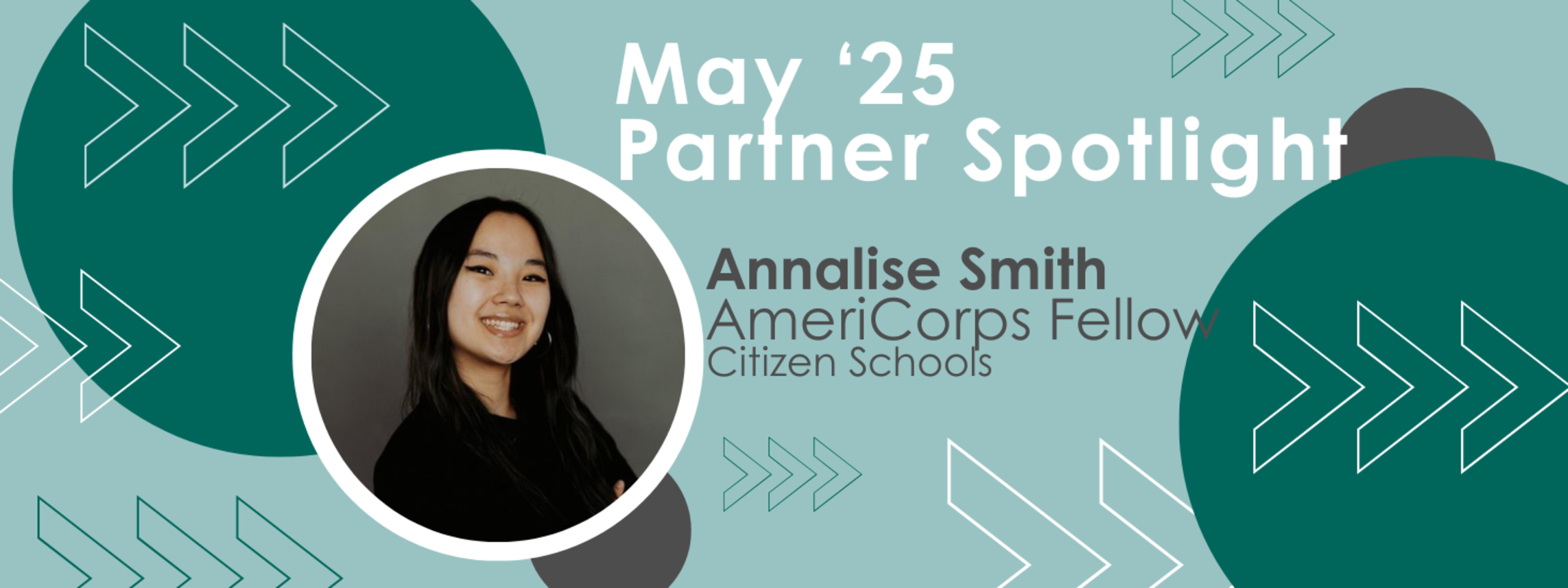
Annalise Smith Partner Spotlight
This month, we're spotlighting Annalise Smith, an AmeriCorps VISTA Fellow whose dedication to community empowerment shines through her work with Citizen Schools. Annalise's passion lies at the intersection of nonprofit excellence, mental wellness advocacy, and inclusivity, making her a vital asset to her host site. Through her work, she aims to create meaningful connections between volunteers and the communities they support, ensuring that everyone feels valued and empowered. Annalise’s commitment to building capacity and promoting well-being exemplifies the core values of AmeriCorps and Citizen Schools, and we’re excited to share her insights and experiences with you.
What drew you to the AmeriCorps and Citizen Schools mission and approach? Share a little about your journey that led you to CS. My journey to my work with AmeriCorps and Citizen Schools began with a passion for diversity, inclusion, and community service. At 15, as a high school sophomore, I started taking college coursework and founded a youth organization dedicated to diversity and inclusion. Growing up in Springfield, Ohio, as a Taiwanese adoptee, I became very passionate about the importance of inclusion. We organized events on my high school campus, including a charitable Women's History Month basketball tournament that benefited a women's shelter.
I had previously done a lot of volunteer work and wanted to continue that journey. I got involved with my college’s chapter of Phi Theta Kappa, an international honor society for two-year colleges, serving as the Vice President of Service. My favorite and most significant PTK service project is called "Love Letters to Ourselves," which is an interactive presentation where participants are challenged to write letters to themselves from the perspective of somebody who loves them unconditionally. The project became an international campaign, collecting nearly 300 letters across multiple states, sovereign nations, and conferences, showing that many people deal with the same struggles. I also initiated a Mental Health and Wellness Fair, at my college which is now an annual event, emphasizing interactive engagement instead of passive information sharing.
Come last April, I was running for the highest leadership position in my organization (PTK), International President. I ran because I was struggling with a very long depressive episode, feeling like I didn't know what to do, at a roadblock in my life. I had graduated high school and college at 16, not because I was "the best ever," but because I wanted to get away from my life. I wanted to be done with everything and run off. I was selected for the position by thousands of my peers. I've been doing that for the past year and my term just recently ended. In early April, we went to our International Convention, Catalyst, where I was the host and a keynote speaker. I was able to give my keynote speech to an audience of more than 3,000 attendees regarding my Love Letters project and how the stories we tell ourselves shape our lives. Moreover, keynote speakers I spoke alongside were Steve Burns from Blue's Clues, Miguel Cervantes from Broadway, and Olympic medalist Lori Hernandez; all amazing inspirations for our members and me, and an experience I won’t forget.
Beginning my term last April, I realized I had a year left to be in college and to work. I wanted to start my career and stay in the nonprofit sector before getting my bachelor's degree. I didn't go to undergrad school right after graduating from high school and college because I didn't know what to do. I didn't want to waste money on a degree I'd throw away. So I held off. I was drawn to AmeriCorps because of its structure and mission. The fact that AmeriCorps connects people with a variety of nonprofit programs is great. It's hard to get into the nonprofit field without an "in” but this program changed that and gave me so many new opportunities. Furthermore, I really wanted to move to New York or away from Ohio and we really lack these kinds of opportunities. Now, I live in the Bronx, New York! I've always been invested in my education and being a mentor. I've been a private tutor, camp counselor, and after-school program coordinator. I have experience with program development and coordination regarding young children so it's been great to work with Citizen Schools since our mission really align.
What does Experiential Learning (EL) mean to you, and why is it important? What would it look like to truly learn experientially? Experiential Learning is essentially learning through experiencing the world and how the things that you're learning apply to what you would see outside of the classroom. I think that it's a really important tool in a teacher's toolbox to use for their students because I believe most students don't like reading textbooks or listening to lectures. They like to learn by doing.
What it would look like to truly learn experientially is when you're teaching a lesson to students, they are allowed to connect their learning with the real world through a supplemental activity. As an example, at the beginning of this year, we did a project to teach students how the voting system works. This activity pushed students to understand how the branches of the government work as well as taught them that the decisions we make as citizens have consequences. These kinds of methods can teach students the real concepts that they learn in the classroom instead of just knowing facts on a table. Students need to be able to understand concepts of learning on a level that requires critical thinking and not just “knowing”.
What do you believe is the best first step towards advancing the future of learning? What is necessary to make it successful? I think what matters to students is to know that their teachers care. The best first step towards advancing the future of learning is to understand our students and to connect with them. In classes of 30, that can be difficult, but that means schools need to do their best to lower the teacher-to-student ratio. Obviously, there are funding issues, but in a perfect world, this would be ideal. When you understand students, and you care, you work to help them learn. There are many situations I’ve heard of over the years, for example, the mom of a girl I used to tutor reached out to me to tell me that her daughter was struggling with understanding a topic of Chemistry but her teacher was unable to find a way to connect with her in an individualized way to work through it with her, leaving her more confused than ever.
The girl was really afraid to fail her test and I don't believe any student should be denied help, even if it’s time-consuming or seems pointless. I recorded a 15-minute video of myself where I went through a problem and made an analogy that I knew would resonate with the student. Since the topic was chemical equation balancing, I said something about brownie mix ratio to egg ratio, and she got it. Something simple but different than before can totally change a student's understanding. When you care as a teacher, you find ways to get around learning every student and how they need to learn. Unfortunately, many teachers are burnt out. There needs to be something better for teachers, perhaps courses during their educational degree that offer teachers more tools for their teacher toolbox. However, I do believe the first step to a successful education system is having passionate and mentor-focused teachers.
Who is the most influential mentor you have had throughout your life? What qualities did they impart that you continue to embody in your work? Two people made the biggest difference in my life during times of hopelessness. I’ve always struggled with family issues and not fitting in, but these two inspired me to take leadership.
The first was Michael Payne, my high school principal. He was a tatted, nerdy, hipster guy. He was the "cool principal," a bit of a hot mess, but he cared about the students. When I asked to make my youth organization a school-sponsored club, the CEO told me, no, it was too controversial. This was disheartening because my approach to diversity and inclusion was based on education, knowledge, and unity, never political. I aimed to unite people through understanding, not divide. I felt like I was doing nothing, chipping at a boulder with a pencil. Michael was always in my corner, saying we could still do it, even without official club status. He encouraged me, took time to talk about my ideas, and asked, "How can we do it?" not "We can't do it." He believed in me and my work. He helped me see what it's like to have someone who believes in you.
My other mentor is Nina Wiley, my PTK advisor and Vice President of Student Affairs at my college. She is the kindest, most driven person. If you ask her to do something, she'll do it with full passion and determination. She's been a great mentor. I remember the first day I talked to her. She called me about the Phi Theta Kappa induction. I was volunteering at a food bank. I went to induction after my shift. She talked to me about the organization and suggested I run for Vice President of Service. I did and got the position!
My first international PTK convention was in 2023. At the time, PTK felt like a new beginning. I had been hurt a lot throughout my years in school and focused on classes and work. I didn't have anyone in my life at the time. But, at the convention, I learned that two of my classmates had passed away. This made me realize I had pushed everyone away, and I had regretted that one of them who was previously a close friend was someone I had pushed away as well. Nina was so supportive and empathetic. The night it happened, I can still remember sitting at the hotel dinner table with her and our chapter, too stunned to move before I began sobbing. She took me aside, talked to me, and got me pretzels, a snack that, at the time, meant the world to me. Every day for the next week, she called to check on me.
For the following year, she saw me through the worst time of my life. Despite this, she encouraged me to run for international president. She believed in me when I didn't believe in myself. She followed me through the process even though I felt like I didn’t deserve it. In all honesty, I want to be like her. She's a really great person. She leads her life with passion, empathy, and truth, and I couldn’t love and respect her any more than I already do.
Can you share an example of a successful project or activity that you are most proud of this service year? My role focuses on connecting students with volunteer opportunities and creating partnerships. When I arrived, they had no connections so I’ve been working on partnerships. I organized a food pantry at the school and I’ve taken groups of students to an animal shelter in Soho weekly for five weeks. Students even asked to go during winter break. Most activities are field trip oriented and I’ve made partnerships with the Food Bank of NYC, 2 organizations in NY healthcare, and Mercy Center. I also anticipate helping students do things like creating a book box.
The school's mission is to send students to college, and I see the potential in them. I’ve been working with seniors all year, and I recognize they need additional support in areas like writing and workforce skills. This is understandable given their environment in the South Bronx and the challenges of the school system.
I believe the school has a great opportunity to further develop it’s system. They could focus on teaching skills like resume writing, cover letter writing, and applications. Many students haven’t had exposure to these areas. By providing this support, they can help students feel more prepared for the real world.
I’ve been assisting students with signing up for volunteer hours, and I see this as a chance to help them build confidence and skills. While there are some logistical considerations due to their age, I believe we can find ways to make the required 25 volunteer hours a positive and achievable experience.