
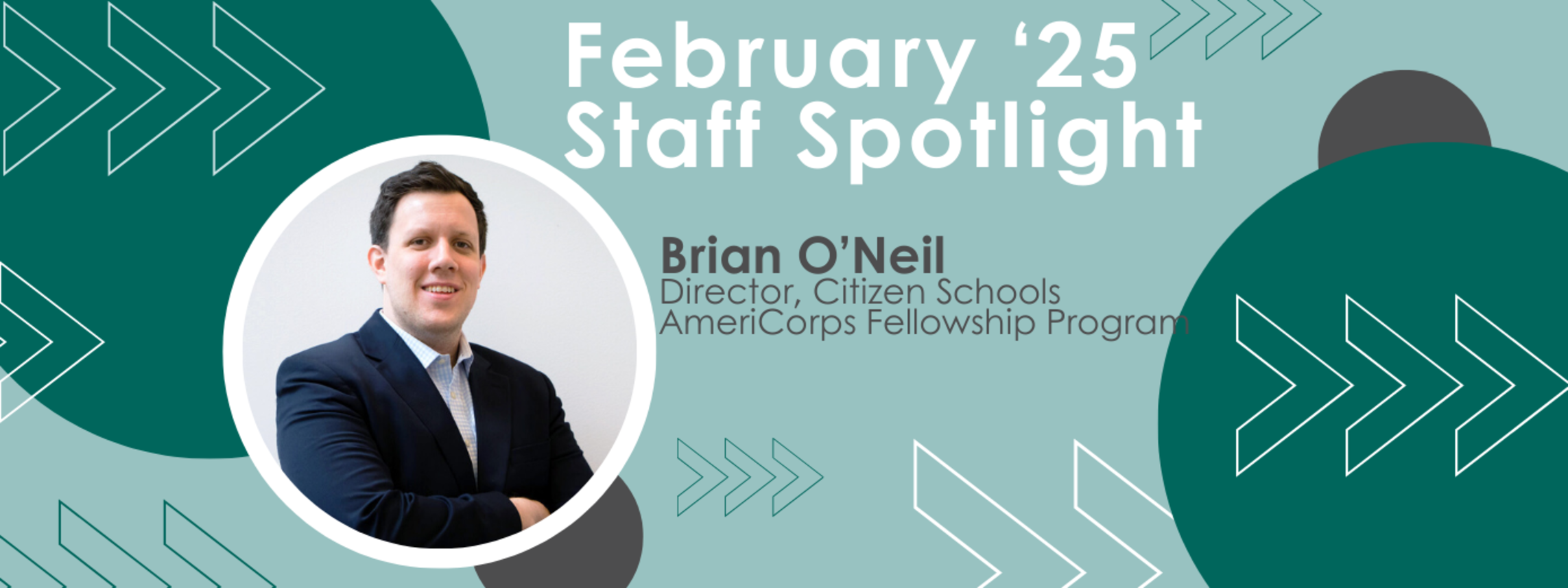
New Staff Spotlight Series Kick Off with Brian O'Neil!
This month, we are kicking off a new Spotlight series focused on the Citizen Schools staff. Each of our staff members make crucial, daily contributions to activate our mission of helping all students thrive in school and beyond through hands-on learning and career mentors. They are an incredibly passionate group whose dedication to mission-driven work comes through the moment you start talking to them about students and education. We hope to share more about who we are, in an effort to share the full Citizen Schools story with our network.
For our first release, we sat down with one of our longest tenured team members, Brian O’Neil. Brian is a member of our Program Leadership Team serving as the Director of the Citizen Schools AmeriCorps Fellowship. His experience as a previous AmeriCorps VISTA member and his commitment to student and community voice make him the perfect leader for this program. We discuss some of his favorite Citizen Schools moments and talk about ways we can truly innovate the future of education.
What drew you to the Citizen Schools mission and what continues to drive you to activate this vision? I've been at Citizen Schools, in a bunch of different roles, for a long time now, well over a decade at this point. Prior to joining the organization, I worked on political campaigns and I thought that that was going to be my career path. I really loved working in the field, talking to voters, and trying to get people interested in engaging in their community by exercising their right to vote. I found that really fulfilling. Through my work in politics, I learned a lot about AmeriCorps, the federal agency for national service and volunteerism, and knew I wanted to do a year of service shortly after graduating college. I found Citizen Schools through AmeriCorps, and interviewed with Citizen Schools New Jersey, and completed a year of AmeriCorps VISTA service at Citizen Schools in Newark, New Jersey.
I quickly found a lot of similarities between my work on political campaigns and Citizen Schools. Some of my favorite elements of my previous experience carried through, like inspiring others to take part in their community and getting people involved, but it was for an even more noble cause by helping kids identify and achieve their dreams. That’s one of the things I love most about Citizen Schools is that we're trying to mobilize the country to take an active part in the lives of kids and to inspire them and prepare them. Our old slogan always used to be, everybody has an expertise and passion that they can share with young people. This concept really stuck with me over the years, the core of our model is about mobilizing adults to share their passion with kids and inspire them to see the world in a new way.
What does Experiential Learning (EL) mean to you, and why is it important? What would it look like to truly learn experientially? I think Experiential Learning means learning through experiences, which means that there's some sort of real world stakes to what you're learning. It has to be relevant to the students and not abstract. I am sure we can all remember being in school and thinking, “Why do I need to learn the pythagorean theorem?” or other abstract concepts. I know I was definitely one of those students. Education needs to be laser focused on our students’ actual lives and the lives of those around them. And it needs to be hands-on in nature, so that they're really not just reading a book and writing an essay, but they're reading the book and applying lessons that they've learned to some sort of project that is important to them.
What do you believe is the best first step towards advancing the future of learning? What is necessary to make it successful? I think some crucial elements to a greater future of learning are making it truly student centric and giving plenty of opportunities for learners to go through material at their own pace. Students should be given the opportunity to identify what they want to learn more about and explore learning that way. In general I think the Industrial Era design of our public education system was meant to create workers that had very specific skills for very specific jobs. Our lived experience in the 21st century is completely different and therefore our kids need different skills and experiences to thrive. We need to create independent thinkers, problem solvers, great collaborators, and people that can think critically about how to make the world a better place through innovation and the STEM disciplines.
To create these outcomes for our learners, there are a lot of steps necessary to make it successful. One element is to de-emphasize standardized testing to start and realize that as a country we are great at so many things and we need to tap into those approaches with learning. We are great at building innovative businesses and great technology so we should focus on how to do that with students and worry less about how we're competing with standardized test scores. And so I think we need to disrupt that system and make it more about what kids are building and developing and making in their education - and not just testing.
Who is the most influential mentor you have had throughout your life? What qualities did they impart that you continue to embody in your work? One of the most influential mentors I've ever had in my life was my AmeriCorps VISTA supervisor, Bing Howell, who now serves as the chair of the Citizen Schools Board, which is super cool to see. He was my first supervisor for a full time position in my life, and he was amazing at helping me develop so many skills and really taking the time to get into the weeds with me. We would work on how you do a specific thing in Excel, or around developing very concrete skill sets and he would be tireless and have infinite patience with me.
He was focused on my learning and development as a supervisor which I valued so much. He also had such an open door policy when working with him and throughout my career afterwards, and shows he genuinely cares about me and will always be there if I have questions or need support on anything. He did that as my supervisor and he's done that as my mentor and that really is an incredible quality. I often think that I may have learned more in one year working for Bing than I learned in four years of college.
What is the most successful and/or unique example of educators and mentors working together to create an impact on students that you have seen? I remember one of my first assignments at Citizen Schools was to write a section in our newsletter focused on a student success story. I interviewed one of our sixth graders. They were taking an apprenticeship that was called “Zoom 3003.” As part of this apprenticeship, their task was to envision and build a prototype for a school built in the year 3003. Their career mentor was a real world architect that was helping to guide them along the way. At first, they were a typical sixth grade student, not really answering me fully, just short answers to my questions about their experience at Citizen Schools. But as soon as I started talking about their partnership with the architect, they just started gushing about how cool it was. They told me they went on a really incredible field trip, where they went to an abandoned lot in their community, and they decided that this is where they would imagine their school would be built in 3003. Their “Citizen Teacher”, the real world architect, explained to them how they needed to measure the lot so that they could tell how much square footage the school could be and how many levels it would be. Unsolicited, the student told me that it was one of the first times that they understood why they needed to learn their multiplication tables. It was this “AHA” moment for me, and for the student, that getting outside of a classroom and into the real world to apply what you're learning in the classroom is so powerful.
I was one of those students growing up that was always questioning, why do I need to learn this? And I think that was a really incredible moment for me, because I could see the student putting the dots together in real time. I think that the fact that they saw this architect applying mathematical concepts to something tangible, it clicked that they could actually do this in the real world and that's why they need to learn these academic concepts. So that was a real incredible moment for me when I fell in love with the Citizen Schools model and haven't looked back a decade later now.